Search the SPREP Catalogue

Refine Search Results

Available Online

Available Online

170 result(s) found.

Sort by

You searched for

  • Author United Nations Environment Programme
    X
Quantification and magnitude of losses and damages resulting from the impacts of climate change: modelling the transformational impacts and costs of sea level rise in the Caribbean
Climate Change Resilience
Available Online

Simpson, M.C...[et al.]

2010
The inextricable links between climate change and sustainable development have been increasingly recognised over the past decade. In 2007, the Intergovernmental Panel on Climate Change (IPCC)1 concluded with very high confidence that climate change would impede the ability of many nations to achieve sustainable development by mid-century and become a security risk that would steadily intensify, particularly under greater warming scenarios. Article 4.8 of the United Nations Framework Convention on Climate Change (UNFCCC) lists several groups of countries that merit particular consideration for assistance to adapt to climate change “especially: (a) small island countries, (b) countries with low-lying coastal areas, c) countries with areas prone to natural disasters.” Small Island Developing States (SIDS) have characteristics which make them particularly vulnerable to the effects of climate change, sea level rise (SLR) and extreme events, including: relative isolation, small land masses, concentrations of population and infrastructure in coastal areas, limited economic base and dependency on natural resources, combined with limited financial, technical and institutional capacity for adaptation.2
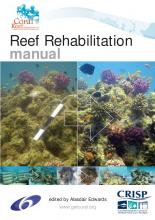
Reef rehabilitation manual
Climate Change Resilience
Available Online

Edwards, Alasdair...[et al.]

2010
This Reef Rehabilitation Manual is intended to complement the Reef Restoration Concepts & Guidelines1 and provide more detailed hands-on advice, based on lessons-learnt from previous experience, on how to carry out coral reef rehabilitation in a responsible and cost-effective manner. The two booklets should be used together. We build on the work of many people, notably Maragos (1974), Miller et al. (1993), Harriett and Fisk (1995), Heeger and Sotto (2000), Clark (2002), Job et al. (2003), Omori and Fujiwara (2004) and Precht (2006)2-9, who have provided a considerable body of advice on restoring reefs (see References). Despite considerable advances over the last 35 years, coral reef restoration is still in its infancy as a discipline. A few rehabilitation projects appear to have been successful at scales of up to a few hectares; many, perhaps most, have failed or not met original expectations. The primary aims of this manual are 1) to reduce the proportion of reef rehabilitation projects that fail, 2) to introduce protocols for methods that could allow larger areas of degraded reef to be repopulated with corals whilst minimizing collateral damage to reefs where corals are sourced, 3) to highlight factors to take into consideration at the planning stage so as to minimize the risk of failure, and 4) to underline the current limitations of reef rehabilitation. The focus is on corals because these are the keystone species that give structure and topographic complexity to coral reef ecosystems. Unfortunately, they are also among the taxonomic groups most vulnerable to global climate change.
An overview of modeling climate change : impacts in the Caribbean region with contribution from the Pacific Islands, United Nations Development Programme (UNDP), Barbados, West Indies
Climate Change Resilience, Biodiversity Conservation
Available Online

Simpson, M.C...[et al.]

2009
The nations of CARICOM16 in the Caribbean together with Pacific island countries contribute less than 1% to global greenhouse gas (GHG) emissions (approx. 0.33%17 and 0.03%18 respectively), yet these countries are expected to be among the earliest and most impacted by climate change in the coming decades and are least able to adapt to climate change impacts. These nations’ relative isolation, small land masses, their concentrations of population and infrastructure in coastal areas, limited economic base and dependency on natural resources, combined with limited financial, technical and institutional capacity all exacerbates their vulnerability to extreme events and climate change impacts. Stabilising global GHG emissions and obtaining greater support for adaptation strategies are fundamental priorities for the Caribbean Basin and Pacific island countries. CARICOM leaders recently unveiled their collective position that global warming should be held to no more than 1.5°C19 and continue to develop a Climate Change Strategic Plan. The Pacific island countries have expressed their priorities for addressing climate change regionally through the Pacific Leaders’ Call to Action on Climate Change20 and the Pacific Islands Framework for Action on Climate Change 2006-2015.21