Search the SPREP Catalogue

Refine Search Results

Available Online

Available Online

92 result(s) found.

Sort by

You searched for

  • Author PACC
    X
Liste Préventive des Espèces Exotiques Envahissantes de Wallis et Futuna - Plan d'intervention rapide et fiches techniques des espèces
Biodiversity Conservation, BRB
Available Online

Bioconsulting

,

Service Territorial de l'Environnement de Wallis et Futuna

2024
La liste préventive des espèces exotiques envahissantes de Wallis et Futuna a été créée en 2024 par une révision de la règlementation, à la suite d'une prestation d’une biologiste, et de la consultation d’associations et de services du territoire. Elle répertorie 123 espèces absentes du territoire mais présentes dans la région et dont Wallis et Futuna entend se préserver. Le document compile des fiches techniques de reconnaissance et de gestion des 123 espèces figurant sur la liste préventive, relatives aux milieux terrestres, humides et de rivières et marins. Le document détaille également les 6 étapes du plan d'intervention rapide élaboré pour répondre aux introductions d'espèces exotiques envahissantes à Wallis et Futuna : (i) réceptionner le signalement, et collecter les informations; (ii) confirmer l'identification de l'espèce; (iii) améliorer la connaissance sur la répartition de l'espèce; (iv) évaluer la situation et choisir l'option de gestion; (v) élaborer et mettre en place un plan d'intervention et (vi) veiller.
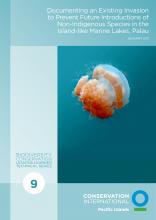
Documenting an existing invasion to prevent future introductions of non-indigenous species in the island-like marine lakes, Koror, Palau
Biodiversity Conservation, BRB
Available Online

Patris, Sharon ... [et al.]

2011
This document is part of a technical report series on conservation projects funded by the Critical Ecosystem Partnership Fund (CEPF) and the Conservation International Pacific Islands Program (CI-Pacific). The main purpose of this series is to disseminate project findings and successes to a broader audience of conservation professionals in the Pacific, along with interested members of the public and students. The reports are being prepared on an ad-hoc basis as projects are completed and written up. In most cases the reports are composed of two parts, the first part is a detailed technical report on the project which gives details on the methodology used, the results and any recommendations. The second part is a brief project completion report written for the donor and focused on conservation impacts and lessons learned. The CEPF fund in the Polynesia-Micronesia region was launched in September 2008 and will be active until 2013. It is being managed as a partnership between CI Pacific and CEPF. The purpose of the fund is to engage and build the capacity of non-governmental organizations to achieve terrestrial conservation. The total grant envelope is approximately US$6 million, and focuses on three main elements: the prevention, control and eradication of invasive species in key biodiversity areas (KBAs); strengthening the conservation status and management of a prioritized set of 60 KBAs and building the awareness and participation of local leaders and community members in the implementation of threatened species recovery plans.