Search the SPREP Catalogue

Refine Search Results

Language

Available Online

Available Online

88 result(s) found.

Sort by

You searched for

  • Author Asian Development Bank
    X
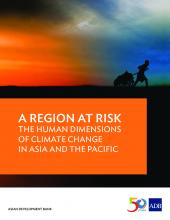
A region at risk - The human dimensions of climate change in Asia and the Pacific
Climate Change Resilience, Biodiversity Conservation
Available Online

Asian Development Bank

2017
The Asia and Pacific region is extremely vulnerable to the impacts of climate change. Unabated warming could significantly undo previous achievements of economic development and improvements of living standards. At the same time, the region has both the economic capacity and weight of influence to change the present fossil-fuel based development pathway and curb global emissions. This report sheds light on the regional implications of the latest projections of changes in climate conditions over Asia and the Pacific. The assessment concludes that, even under the Paris consensus scenario in which global warming is limited to 1.5°C to 2°C above preindustrial levels, some of the land area, ecosystems, and socioeconomic sectors will be significantly affected by climate change impacts, to which policy makers and the investment community need to adapt to. However, under a Business-As-Usual (BAU) scenario, which will cause a global mean temperature rise of over 4°C by the end of this century, the possibilities for adaptation are drastically reduced. Among others, climate change impacts such as the deterioration of the Asian “water towers”, prolonged heat waves, coastal sea-level rise and changes in rainfall patterns could disrupt ecosystem services and lead to severe effects on livelihoods which in turn would affect human health, migration dynamics and the potential for conflicts. This assessment also underlines that, for many areas vital to the region’s economy, research on the effects of climate change is still lacking.
Cetacean diversity, common occurrence and community importance in Fijian waters

Batibasaga, Aisake

,

Chand, Prerna

,

Dulunaqio, Sirilo

,

Fox, Margaret

,

Jupiter, Stacy

,

Miller, Cara E.

,

Naisilisili, Waisea

,

Nand, Yashika

,

Sharma-Gounder, Saras

,

Smith, Brian

2016
Fiji has demonstrated a strong commitment to cetacean conservation via national, regional and international plans and agreements. To provide baseline information in support of these efforts, this paper provides an updated listing of cetacean species found in Fijian waters and identifies locations where cetaceans have been noted on a consistent basis. Information for this review was sourced from peer-reviewed publications, field reports, historical whaling records, national consultations, anecdotal and opportunistic sources, as well as a national database held by the Fiji Government's Department of Fisheries. Reliable and recent records were confirmed for 10 cetacean species in Fijian waters. In addition, less reliable records and regional species' information provides support for the occurrence of at least 14 additional species or groups of similar-looking species that could not be identified more specifically. Thirteen hotspot areas within the Fiji Economic Exclusive Zone were preliminarily identified as being particularly important for cetaceans, including numerous sites within the Vatu-i-Ra and Lomaiviti passages and surrounding waters. Issues with the available data include uneven coverage, inherent biases within available sources, and difficulties with species identification and verification in some cases. Nevertheless, it is hoped that this review will provide a reference point from which to move forward with cetacean management and conservation efforts in Fiji.
Cetacean diversity, common occurrence and community importance in Fijian waters
Environmental Governance, Biodiversity Conservation

Batibasaga, Aisake

,

Chand, Prerna

,

Dulunaqio, Sirilo

,

Fox, Margaret

,

Jupiter, Stacy

,

Miller, Cara E.

,

Naisilisili, Waisea

,

Nand, Yashika

,

Sharma-Gounder, Saras

,

Smith, Brian

2016
Fiji has demonstrated a strong commitment to cetacean conservation via national, regional and international plans and agreements. To provide baseline information in support of these efforts, this paper provides an updated listing of cetacean species found in Fijian waters and identifies locations where cetaceans have been noted on a consistent basis. Information for this review was sourced from peer-reviewed publications, field reports, historical whaling records, national consultations, anecdotal and opportunistic sources, as well as a national database held by the Fiji Government’s Department of Fisheries. Reliable and recent records were confirmed for 10 cetacean species in Fijian waters. In addition, less reliable records and regional species’ information provides support for the occurrence of at least 14 additional species or groups of similar-looking species that could not be identified more specifically. Thirteen hotspot areas within the Fiji Economic Exclusive Zone were preliminarily identified as being particularly important for cetaceans, including numerous sites within the Vatu-i-Ra and Lomaiviti passages and surrounding waters. Issues with the available data include uneven coverage, inherent biases within available sources, and difficulties with species identification and verification in some cases. Nevertheless, it is hoped that this review will provide a reference point from which to move forward with cetacean management and conservation efforts in Fiji.