
Search the SPREP Catalogue

2 result(s) found.

Sort by

You searched for

  • Publication Year 2017
    X
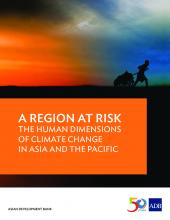
A region at risk - The human dimensions of climate change in Asia and the Pacific
Climate Change Resilience, Biodiversity Conservation
Available Online

Asian Development Bank

2017
The Asia and Pacific region is extremely vulnerable to the impacts of climate change. Unabated warming could significantly undo previous achievements of economic development and improvements of living standards. At the same time, the region has both the economic capacity and weight of influence to change the present fossil-fuel based development pathway and curb global emissions. This report sheds light on the regional implications of the latest projections of changes in climate conditions over Asia and the Pacific. The assessment concludes that, even under the Paris consensus scenario in which global warming is limited to 1.5°C to 2°C above preindustrial levels, some of the land area, ecosystems, and socioeconomic sectors will be significantly affected by climate change impacts, to which policy makers and the investment community need to adapt to. However, under a Business-As-Usual (BAU) scenario, which will cause a global mean temperature rise of over 4°C by the end of this century, the possibilities for adaptation are drastically reduced. Among others, climate change impacts such as the deterioration of the Asian “water towers”, prolonged heat waves, coastal sea-level rise and changes in rainfall patterns could disrupt ecosystem services and lead to severe effects on livelihoods which in turn would affect human health, migration dynamics and the potential for conflicts. This assessment also underlines that, for many areas vital to the region’s economy, research on the effects of climate change is still lacking.
Opportunities and constraints for implementing integrated land-sea management on islands
Biodiversity Conservation

Albert, Simon

,

Jupiter, Stacy

,

Klein, Carissa J.

,

Mangubhai, Sangeeta

,

Nelson, Joanna

,

Teneva, Lida

,

Tulloch, Vivitskaia J.

,

Watson, James E.M.

,

Wenger, Amelia

,

White, Alan T.

2017
Despite a growing body of literature on integrated land–sea management (ILSM), very little critical assessment has been conducted in order to evaluate ILSM in practice on island systems. Here we develop indicators for assessing 10 integrated island management principles and evaluate the performance of planning and implementation in four island ILSM projects from the tropical Pacific across different governance structures. We find that where customary governance is still strongly respected and enabled through national legislation, ILSM in practice can be very effective at restricting access and use according to fluctuations in resource availability. However, decision-making under customary governance systems may be vulnerable to mismanagement. Governmentled ILSM processes have the potential to design management actions that address the spatial scale of ecosystem processes and threats within the context of national policy and legislation, but may not fully capture broad stakeholder interests, and implementation may be poorly coordinated across highly dispersed island archipelagos. Private sector partnerships offer unique opportunities for resourcing island ILSM, although these are highly likely to be geared towards private sector interests that may change in the future and no longer align with community and/or national objectives. We identify consistent challenges that arise during island ILSM planning and implementation and offer recommendations for improvement.