Search the SPREP Catalogue

3 result(s) found.

Sort by

You searched for

  • Author Holmes, Nick D.
    X
  • Publication Year 2017
    X
Estimating burdens of neglected tropical zoonotic diseases on islands with introduced mammals
BRB
Available Online

Croll, Donald A.

,

Holmes, Nick D.

,

Kilpatrick, A. Marm.

,

Newton, Kelly M.

,

Spatz, Dena R.

,

Tershy, Bernie.

,

de Wit, Luz A.

2017
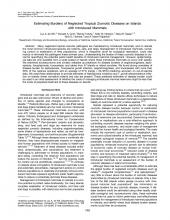
Many neglected tropical zoonotic pathogens are maintained by introduced mammals, and on islands the most common introduced species are rodents, cats, and dogs. Management of introduced mammals, including control or eradication of feral populations, which is frequently done for ecological restoration, could also reduce or eliminate the pathogens these animals carry. Understanding the burden of these zoonotic diseases is crucial for quantifying the potential public health benefits of introduced mammal management. However, epidemiological data are only available from a small subset of islands where these introduced mammals co-occur with people. We examined socioeconomic and climatic variables as predictors for disease burdens of angiostrongyliasis, leptospirosis, toxoplasmosis, toxocariasis, and rabies from 57 islands or island countries. We found strong correlates of disease burden for leptospirosis, Toxoplasma gondii infection, angiostrongyliasis, and toxocariasis with more than 50% of the variance explained, and an average of 57% (range = 32–95%) predictive accuracy on out-of-sample data. We used these relationships to provide estimates of leptospirosis incidence and T. gondii seroprevalence infection on islands where nonnative rodents and cats are present. These predicted estimates of disease burden could be used in an initial assessment of whether the costs of managing introduced mammal reservoirs might be less than the costs of perpetual treatment of these diseases on islands.
Globally threatened vertebrates on islands with invasive species.
BRB
Available Online

Butchart, Stuart H M

,

Ceballos, Gerardo

,

Croll Donald A.

,

Genovesi, Piero Genovesi

,

Holmes, Nick D.

,

Spatz, Dena

,

Tershy, Bernie R

,

Zilliacus, Kelly M.

2017
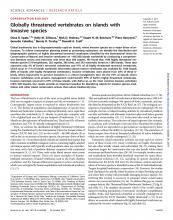
Global biodiversity loss is disproportionately rapid on islands, where invasive species are a major driver of extinctions. To inform conservation planning aimed at preventing extinctions, we identify the distribution and biogeographic patterns of highly threatened terrestrial vertebrates (classified by the International Union for Conservation of Nature) and invasive vertebrates on ~465,000 islands worldwide by conducting a comprehensive literature review and interviews with more than 500 experts. We found that 1189 highly threatened vertebrate species (319 amphibians, 282 reptiles, 296 birds, and 292 mammals) breed on 1288 islands. These taxa represent only 5% of Earth's terrestrial vertebrates and 41% of all highly threatened terrestrial vertebrates, which occur in 1% of islands worldwide. Information about invasive vertebrates was available for 1030 islands (80% of islands with highly threatened vertebrates). Invasive vertebrates were absent from 24% of these islands, where biosecurity to prevent invasions is a critical management tool. On the 76% of islands where invasive vertebrates were present, management could benefit 39% of Earth’s highly threatened vertebrates. Invasive mammals occurred in 97% of these islands, with Rattus as the most common invasive vertebrate (78%; 609 islands). Our results provide an important baseline for identifying islands for invasive species eradication and other island conservation actions that reduce biodiversity loss.
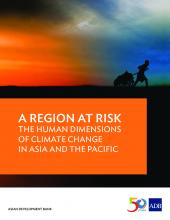
A region at risk - The human dimensions of climate change in Asia and the Pacific
Climate Change Resilience, Biodiversity Conservation
Available Online

Asian Development Bank

2017
The Asia and Pacific region is extremely vulnerable to the impacts of climate change. Unabated warming could significantly undo previous achievements of economic development and improvements of living standards. At the same time, the region has both the economic capacity and weight of influence to change the present fossil-fuel based development pathway and curb global emissions. This report sheds light on the regional implications of the latest projections of changes in climate conditions over Asia and the Pacific. The assessment concludes that, even under the Paris consensus scenario in which global warming is limited to 1.5°C to 2°C above preindustrial levels, some of the land area, ecosystems, and socioeconomic sectors will be significantly affected by climate change impacts, to which policy makers and the investment community need to adapt to. However, under a Business-As-Usual (BAU) scenario, which will cause a global mean temperature rise of over 4°C by the end of this century, the possibilities for adaptation are drastically reduced. Among others, climate change impacts such as the deterioration of the Asian “water towers”, prolonged heat waves, coastal sea-level rise and changes in rainfall patterns could disrupt ecosystem services and lead to severe effects on livelihoods which in turn would affect human health, migration dynamics and the potential for conflicts. This assessment also underlines that, for many areas vital to the region’s economy, research on the effects of climate change is still lacking.