Search the SPREP Catalogue

Refine Search Results

Language

Available Online

Available Online

89 result(s) found.

Sort by

You searched for

  • Author Asian Development Bank
    X
Going to scale: reviewing where we’ve been and where we need to go in invasive vertebrate eradications
Available Online

Hagen, E.

,

Holmes, N.

,

Howald, G.

,

Keitt, B.

,

Poiani, K.

2019
We are on the edge of the sixth mass extinction on Earth. Islands represent ca. 5% of the earth’s land area yet are home to 61% of extinctions in the past 500 years, and currently support 39% of critically endangered species. Invasive species are a leading cause of extinction and endangerment on islands. Invasive vertebrates, particularly mammals, are among some of the most damaging invasive species on islands. Eradicating invasive mammals is an increasingly utilised conservation tool. Nevertheless, conservation intervention needs greatly outstrip the island restoration community’s capacity. There are thousands of islands where invasive vertebrates are driving species toward extinction. So, how can the effort be matched to the scale of the problem? One approach is to improve outreach and communications to increase the resources available for projects. There are great stories; but these need to be told compellingly and repeatedly. Increasing social acceptance and support for invasive species eradications will reduce project costs associated with stakeholder engagement. Broadening the funding base can be accomplished by building stronger cost benefit valuations as well as engaging funders of climate change, marine conservation, human wellbeing, and food security. Furthermore, it is important to build upon existing partnerships to create or grow coalitions that can access these resources as part of broader, holistic efforts to address multiple conservation issues.
No detection of brodifacoum residues in the marine and terrestrial food web three years after rat eradication at Palmyra Atoll, Central Pacific
Available Online

Holmes, N.

,

Howald, G.

,

Shiels, A.

,

Wegmann, A.

2019
Invasive alien species represent one of the greatest threats to native plants and animals on islands. Rats (Rattus spp.) have invaded most of the world’s oceanic islands, causing lasting or irreversible damage to ecosystems and biodiversity. To counter this threat, techniques to eradicate invasive rats from islands have been developed and applied across the globe. Eradication of alien rats from large or complex island ecosystems has only been successful with the use of bait containing a rodenticide. While effective at eradicating rats from islands, rodenticide can persist in the ecosystem longer than the time required to eradicate the target rat population and can potentially harm non-target species. However, the persistence of rodenticides in ecosystems following rat eradication campaigns is poorly understood, though predictions can be made based on the chemical properties of the rodenticide and the environment it is applied in. Brodifacoum, a relatively persistent second-generation anticoagulant, was used to successfully eradicate rats from Palmyra Atoll. With this study, we evaluated the persistence of brodifacoum residues in terrestrial and marine species at Palmyra Atoll (Northern Line Islands) three years after rat eradication. We collected 44 pooled samples containing 121 individuals of the following: mullet (Moolgarda engeli), cockroaches (Periplaneta sp.), geckos (Lepidodactylus lugubris), hermit crabs (Coenobita perlatus), and fiddler crabs (Uca tetragonon). Despite detection of brodifacoum residue in all five of the species sampled in this study 60 days after the application of bait to Palmyra Atoll in 2011, brodifacoum residue was not found in any of the pooled samples collected three years after bait application. Our study demonstrates how brodifacoum residues are unlikely to persist in the marine and terrestrial food web, in a wet tropical environment, three years after rat eradication.
Considerations and consequences when conducting aerial broadcast applications during rodent eradications
Biodiversity Conservation, BRB
Available Online

Gill, C.

,

Griffi ths, R.

,

Holmes, N.

,

Howald, G.

,

Will, D.

2019
Aerial broadcast application is currently one of the most common methods for conducting rodent eradications on islands, particularly islands greater than 100 ha or with complex and difficult topography where access by ground teams is difficult. Overall, aerial broadcast applications have a high success rate, but can be burdened by logistical, regulatory, and environmental challenges. This is particularly true for islands where complex shorelines, sheer terrain, and the interface with the marine environment pose additional risks and concerns. Using data collected during ten eradication projects we investigate the influence that operational realities have on broadcast applications. We tested the association between the amount of bait used and island size, topography, and the desire to reduce bait application into the marine environment and then compared planned bait application to actual bait application quantities. Based on our results, islands of decreasing size and increasing coastal complexity tended to use more bait than anticipated and experienced greater variability in localised bait densities. During operations, we recommend analysing flight data to identify treated areas with localised bait densities that fall below the target application rate. We recommend that areas with low localised bait densities may result in biologically significant gaps that should receive an additional application of bait based on project risk variables such as target home range size, non-target bait competitors, and alternative foods. We also recommend a common language for discussing aerial broadcast applications and where future work can be done to improve operational decision making.
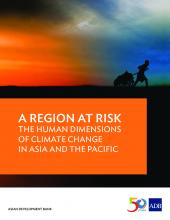
A region at risk - The human dimensions of climate change in Asia and the Pacific
Climate Change Resilience, Biodiversity Conservation
Available Online

Asian Development Bank

2017
The Asia and Pacific region is extremely vulnerable to the impacts of climate change. Unabated warming could significantly undo previous achievements of economic development and improvements of living standards. At the same time, the region has both the economic capacity and weight of influence to change the present fossil-fuel based development pathway and curb global emissions. This report sheds light on the regional implications of the latest projections of changes in climate conditions over Asia and the Pacific. The assessment concludes that, even under the Paris consensus scenario in which global warming is limited to 1.5°C to 2°C above preindustrial levels, some of the land area, ecosystems, and socioeconomic sectors will be significantly affected by climate change impacts, to which policy makers and the investment community need to adapt to. However, under a Business-As-Usual (BAU) scenario, which will cause a global mean temperature rise of over 4°C by the end of this century, the possibilities for adaptation are drastically reduced. Among others, climate change impacts such as the deterioration of the Asian “water towers”, prolonged heat waves, coastal sea-level rise and changes in rainfall patterns could disrupt ecosystem services and lead to severe effects on livelihoods which in turn would affect human health, migration dynamics and the potential for conflicts. This assessment also underlines that, for many areas vital to the region’s economy, research on the effects of climate change is still lacking.