Search the SPREP Catalogue

Refine Search Results

Language

Available Online

Available Online

87 result(s) found.

Sort by

You searched for

  • Author Asian Development Bank
    X
A region at risk - The human dimensions of climate change in Asia and the Pacific
Climate Change Resilience, Biodiversity Conservation
Available Online

Asian Development Bank

2017
The Asia and Pacific region is extremely vulnerable to the impacts of climate change. Unabated warming could significantly undo previous achievements of economic development and improvements of living standards. At the same time, the region has both the economic capacity and weight of influence to change the present fossil-fuel based development pathway and curb global emissions. This report sheds light on the regional implications of the latest projections of changes in climate conditions over Asia and the Pacific. The assessment concludes that, even under the Paris consensus scenario in which global warming is limited to 1.5°C to 2°C above preindustrial levels, some of the land area, ecosystems, and socioeconomic sectors will be significantly affected by climate change impacts, to which policy makers and the investment community need to adapt to. However, under a Business-As-Usual (BAU) scenario, which will cause a global mean temperature rise of over 4°C by the end of this century, the possibilities for adaptation are drastically reduced. Among others, climate change impacts such as the deterioration of the Asian “water towers”, prolonged heat waves, coastal sea-level rise and changes in rainfall patterns could disrupt ecosystem services and lead to severe effects on livelihoods which in turn would affect human health, migration dynamics and the potential for conflicts. This assessment also underlines that, for many areas vital to the region’s economy, research on the effects of climate change is still lacking.
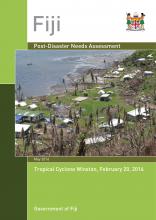
Fiji Post-Disaster Needs Assessment : Tropical Cyclone Winston, February 20, 2016
Biodiversity Conservation
Available Online

Ester, Simone

2016
On Saturday February 20, 2016, Tropical Cyclone (TC) Winston, an extremely destructive Category 5 cyclone, struck Fiji. TC Winston was the first Category 5 cyclone to directly impact Fiji and the most intense cyclone on record to affect the country.1 Fiji’s Eastern Division was the first to be struck, with Koro, Ovalau and Taveuni Islands sustaining severe damage. The cyclone swept across Fiji’s islands, reaching its peak strength shortly before making landfall on the country’s largest island, Viti Levu. Maximum average wind speeds reached 233km/hour and wind gusts peaked at around 306km/hour, making Winston one of the most powerful cyclones ever recorded in the Southern Hemisphere.2 In addition to the extreme wind speeds, many islands were flooded by storm surges, including Koro Island and the southern coast of Fiji’s secondlargest island, Vanua Levu, which was inundated almost 200 meters inland in some areas. Following TC Winston’s passage from Fiji, reports emerged of widespread damage and destruction, with the cyclone impacting approximately 540,400 people, equivalent to 62 percent of the country’s total population.3 The storm brought down the power and communications systems linking the islands, with approximately 80 percent of the nation’s population losing power, including the entire island of Vanua Levu, and 44 fatalities were subsequently confirmed. Entire communities were destroyed and approximately 40,000 people required immediate assistance following the cyclone.4 30,369 houses, 495 schools and 88 health clinics and medical facilities were damaged or destroyed. In addition, the cyclone destroyed crops on a large scale and compromised the livelihoods of almost 60 percent of Fiji’s population.