Search the SPREP Catalogue

Refine Search Results

Language

Available Online

Available Online

88 result(s) found.

Sort by

You searched for

  • Author Asian Development Bank
    X
Global Economic Costs of Aquatic Invasive Alien Species
Biodiversity Conservation, BRB
Available Online

Ahmed, Danish A.

,

Angulo, Elena

,

Briski, Elizabeta

,

Capinha, César

,

Catford, Jane A.

,

Cuthbert, Ross N.

,

Dalu, Tatenda

,

Diagne, Christophe

,

Essl, Franz

,

Gozlan, Rodolphe E.

,

Leroy, Boris

,

Pattison, Zarah

,

Taylor, Nigel G.

,

Verbrugge, Laura

2021
Much research effort has been invested in understanding ecological impacts of invasive alien species (IAS) across ecosystems and taxonomic groups, but empirical studies about economic effects lack synthesis. Using a comprehensive global database, we determine patterns and trends in economic costs of aquatic IAS by examining: (i) the distribution of these costs across taxa, geographic regions, and cost types; (ii) the temporal dynamics of global costs; and (iii) knowledge gaps, especially compared to terrestrial IAS. Based on the costs recorded from the existing literature, the global cost of aquatic IAS conservatively summed to US$345 billion, with the majority attributed to invertebrates (62%), followed by vertebrates (28%), then plants (6%). The largest costs were reported in North America (48%) and Asia (13%) and were principally a result of resource damages (74%); only 6% of recorded costs were from management. The magnitude and number of reported costs were highest in the United States of America and for semi-aquatic taxa. Many countries and known aquatic alien species had no reported costs, especially in Africa and Asia. Accordingly, a network analysis revealed limited connectivity among countries, indicating disparate cost reporting. Aquatic IAS costs have increased in recent decades by several orders of magnitude, reaching at least US$23 billion in 2020. Costs are likely considerably underrepresented compared to terrestrial IAS; only 5% of reported costs were from aquatic species, despite 26% of known invaders being aquatic. Additionally, only 1% of aquatic invasion costs were from marine species. Costs of aquatic IAS are thus substantial, but likely underreported. Costs have increased over time and are expected to continue rising with future invasions. We urge increased and improved cost reporting by managers, practitioners and researchers to reduce knowledge gaps. Few costs are proactive investments; increased management spending is urgently needed to prevent and limit current and future aquatic IAS damages.
Habitat change mediates the response of coral fish populations to terrestrial run-off
Available Online

Albert, Simon

,

Brown, Christopher J.

,

Jupiter, Stacy D.

,

Klein, Carissa

,

Lin, Hsien-Yung

,

Maina, Joseph M.

,

Mumby, Peter J.

,

Tullock, Vivitskaia J. D.

,

Wenger, Amelia S.

2017
ABSTRACT: Coastal fish populations are typically threatened by multiple human activities, including fishing pressure and run-off of terrestrial pollution. Linking multiple threats to their impacts on fish populations is challenging because the threats may influence a species directly, or indirectly, via its habitats and its interactions with other species. Here we examine spatial variation in abundance of coral reef fish across gradients of fishing pressure and turbidity in Fiji. We explicitly account for multiple pathways of influence to test the alternative hypotheses that (1) habitat moderates predation by providing shelter, so habitat loss only affects prey fish populations if there are abundant predators, (2) habitat change co-drives biomass of both prey and predator functional groups. We examined responses of 7 fish functional groups and found that habitat change co-drives both predator and prey responses to turbidity. Abundances of all functional groups were associated with changes in habitat cover; however, the responses of their habitats to turbidity were mixed. Planktivore and piscivore abundance were lower in areas of high turbidity, because cover of their preferred habitats was lower. Invertivore, browser and grazer abundance did not change strongly over the turbidity gradient, because different components of their habitats exhibited both increases and decreases with turbidity. The effects of turbidity on fish populations were minor in areas where fish populations were already depleted by fishing. These findings suggest that terrestrial run-off modifies the composition of reef fish communities indirectly by affecting the benthic habitats that reef fish use.
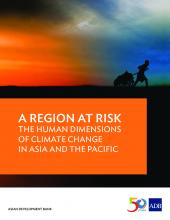
A region at risk - The human dimensions of climate change in Asia and the Pacific
Climate Change Resilience, Biodiversity Conservation
Available Online

Asian Development Bank

2017
The Asia and Pacific region is extremely vulnerable to the impacts of climate change. Unabated warming could significantly undo previous achievements of economic development and improvements of living standards. At the same time, the region has both the economic capacity and weight of influence to change the present fossil-fuel based development pathway and curb global emissions. This report sheds light on the regional implications of the latest projections of changes in climate conditions over Asia and the Pacific. The assessment concludes that, even under the Paris consensus scenario in which global warming is limited to 1.5°C to 2°C above preindustrial levels, some of the land area, ecosystems, and socioeconomic sectors will be significantly affected by climate change impacts, to which policy makers and the investment community need to adapt to. However, under a Business-As-Usual (BAU) scenario, which will cause a global mean temperature rise of over 4°C by the end of this century, the possibilities for adaptation are drastically reduced. Among others, climate change impacts such as the deterioration of the Asian “water towers”, prolonged heat waves, coastal sea-level rise and changes in rainfall patterns could disrupt ecosystem services and lead to severe effects on livelihoods which in turn would affect human health, migration dynamics and the potential for conflicts. This assessment also underlines that, for many areas vital to the region’s economy, research on the effects of climate change is still lacking.