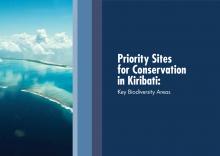
Priority Sites for Conservation in Kiribati: Key Biodiversity Areas

Biodiversity Conservation
Available Online
Anderson, P.
,
van Dijken, S. G.
2013
In 2010, under Kiribatis Programme of Work for Protected Areas (PoWPA), a national ecological gap analysis (GA) was conducted. Its main purpose was to assess how effective the current Protected Areas (PA) network was at achieving Kiribatis National Biodiversity Strategies Action Plan (NBSAP) conservation targets, and in particular to identify priority areas for the expansion of the PA network and priority actions for improved management of existing PAs. A complementary objective was to identify the key gaps in our knowledge of the countrys biodiversity. The Secretariat of the Pacific Regional Environment Programme (SPREP) and Conservation Internationals Pacific Islands Program (CI-PIP) provided technical support to the Kiribati Ministry of Environment, Lands and Agricultural Development (MELAD) to conduct a GA of Key Biodiversity Areas (KBA areas of high biodiversity and conservation value) in Kiribati, and provided advisory support for its PA network design. The KBA approach was applied at the archipelago (Gilbert, Line and Phoenix Islands) level combining terrestrial, coastal and lagoon habitats. The KBA methodology applied here is based on an international standard methodology that focuses on worldwide threatened species. KBA sites all designated at the island level - were identified based on the presence of globally threatened species. The KBA sites (Islands) were then prioritized based on three additional criteria including the frequency of species of local concern as identified by the NBSAP, Kiribati Adaptation Plan (KAP) II mangroves, and the PoWPA phase one consultations; areas of expert concern; and a habitat metric based on habitat diversity and numerical analysis of habitat types.