Search the SPREP Catalogue

Refine Search Results

Language

Available Online

Available Online

90 result(s) found.

Sort by

You searched for

  • Author Asian Development Bank
    X
Habitat change mediates the response of coral fish populations to terrestrial run-off
Available Online

Albert, Simon

,

Brown, Christopher J.

,

Jupiter, Stacy D.

,

Klein, Carissa

,

Lin, Hsien-Yung

,

Maina, Joseph M.

,

Mumby, Peter J.

,

Tullock, Vivitskaia J. D.

,

Wenger, Amelia S.

2017
ABSTRACT: Coastal fish populations are typically threatened by multiple human activities, including fishing pressure and run-off of terrestrial pollution. Linking multiple threats to their impacts on fish populations is challenging because the threats may influence a species directly, or indirectly, via its habitats and its interactions with other species. Here we examine spatial variation in abundance of coral reef fish across gradients of fishing pressure and turbidity in Fiji. We explicitly account for multiple pathways of influence to test the alternative hypotheses that (1) habitat moderates predation by providing shelter, so habitat loss only affects prey fish populations if there are abundant predators, (2) habitat change co-drives biomass of both prey and predator functional groups. We examined responses of 7 fish functional groups and found that habitat change co-drives both predator and prey responses to turbidity. Abundances of all functional groups were associated with changes in habitat cover; however, the responses of their habitats to turbidity were mixed. Planktivore and piscivore abundance were lower in areas of high turbidity, because cover of their preferred habitats was lower. Invertivore, browser and grazer abundance did not change strongly over the turbidity gradient, because different components of their habitats exhibited both increases and decreases with turbidity. The effects of turbidity on fish populations were minor in areas where fish populations were already depleted by fishing. These findings suggest that terrestrial run-off modifies the composition of reef fish communities indirectly by affecting the benthic habitats that reef fish use.
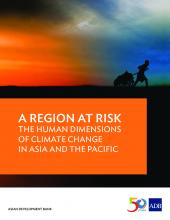
A region at risk - The human dimensions of climate change in Asia and the Pacific
Climate Change Resilience, Biodiversity Conservation
Available Online

Asian Development Bank

2017
The Asia and Pacific region is extremely vulnerable to the impacts of climate change. Unabated warming could significantly undo previous achievements of economic development and improvements of living standards. At the same time, the region has both the economic capacity and weight of influence to change the present fossil-fuel based development pathway and curb global emissions. This report sheds light on the regional implications of the latest projections of changes in climate conditions over Asia and the Pacific. The assessment concludes that, even under the Paris consensus scenario in which global warming is limited to 1.5°C to 2°C above preindustrial levels, some of the land area, ecosystems, and socioeconomic sectors will be significantly affected by climate change impacts, to which policy makers and the investment community need to adapt to. However, under a Business-As-Usual (BAU) scenario, which will cause a global mean temperature rise of over 4°C by the end of this century, the possibilities for adaptation are drastically reduced. Among others, climate change impacts such as the deterioration of the Asian “water towers”, prolonged heat waves, coastal sea-level rise and changes in rainfall patterns could disrupt ecosystem services and lead to severe effects on livelihoods which in turn would affect human health, migration dynamics and the potential for conflicts. This assessment also underlines that, for many areas vital to the region’s economy, research on the effects of climate change is still lacking.
Opportunities and constraints for implementing integrated land-sea management on islands
Biodiversity Conservation

Albert, Simon

,

Jupiter, Stacy

,

Klein, Carissa J.

,

Mangubhai, Sangeeta

,

Nelson, Joanna

,

Teneva, Lida

,

Tulloch, Vivitskaia J.

,

Watson, James E.M.

,

Wenger, Amelia

,

White, Alan T.

2017
Despite a growing body of literature on integrated land–sea management (ILSM), very little critical assessment has been conducted in order to evaluate ILSM in practice on island systems. Here we develop indicators for assessing 10 integrated island management principles and evaluate the performance of planning and implementation in four island ILSM projects from the tropical Pacific across different governance structures. We find that where customary governance is still strongly respected and enabled through national legislation, ILSM in practice can be very effective at restricting access and use according to fluctuations in resource availability. However, decision-making under customary governance systems may be vulnerable to mismanagement. Governmentled ILSM processes have the potential to design management actions that address the spatial scale of ecosystem processes and threats within the context of national policy and legislation, but may not fully capture broad stakeholder interests, and implementation may be poorly coordinated across highly dispersed island archipelagos. Private sector partnerships offer unique opportunities for resourcing island ILSM, although these are highly likely to be geared towards private sector interests that may change in the future and no longer align with community and/or national objectives. We identify consistent challenges that arise during island ILSM planning and implementation and offer recommendations for improvement.
Improving invasive ant eradication as a conservation tool : a review
BRB
Available Online

Hoffman, Benjamin ... et al.

2016
While invasive species eradications are at the forefront of biodiversity conservation, ant eradication failures are common. We reviewed ant eradications worldwide to assess the practice and identify knowledge gaps and challenges. We documented 316 eradication campaigns targeting 11 species, with most occurring in Australia covering small areas (b10 ha). Yellow crazy ant was targeted most frequently, while the bigheaded ant has been eradicated most often. Of the eradications with known outcomes, 144 campaigns were successful, totaling approximately 9500 ha, of which 8300 ha were from a single campaign that has since been partially re-invaded. Three active ingredients, often in combination, are most commonly used: fipronil, hydramethylnon, and juvenile hormone mimics. Active ingredient, bait, and method varied considerablywith respect to species targeted,which made assessing factors of eradication success challenging. We did, however, detect effects by active ingredient, number of treatments, and method on eradication success. Implementation costs increased with treatment area, and median costs were high compared to invasive mammal eradications. Ant eradications are in a phase of increased research and development, and a logical next step for practitioners is to develop best practices. A number of research themes that seek to integrate natural history with eradication strategies and methodologies would improve the ability to eradicate ants: increasing natural history and taxonomic knowledge, increasing the efficacy of active ingredients and baits, minimizing and mitigating non-target risks, developing better tools to declare eradication success, and developing alternative eradication methodologies. Invasive ant eradications are rapidly increasing in both size and frequency, and we envisage that eradicating invasive ants will increase in focus in coming decades given the increasing dispersal and subsequent impacts.